Showing posts with label science. Show all posts

8.10.2021

Skywatch: Perseids Meteor Shower 2021 #astronomy

 The Perseids is the biggest and showiest meteor shower of the year. Every year, it's at the same time-mid August. The peak is August 12th, but you should already be able to view some lovely shooting stars if you have a dark sky.


Even without it being Perseids season, there are 6-10 shooting stars every hour.

The Perseids will appear as quick, small streaks of light. They get their name because they look like they’re coming from the direction of the constellation Perseus.

The Perseids are fragments of the comet Swift-Tuttle, which orbits between the Sun and beyond the orbit of Pluto once every 133 years. Every year, the Earth passes near the path of the comet, and the debris left behind by Swift-Tuttle shows up as meteors in our sky.

Perseus is located under Cassiopeia: looks like a big W to the right of the Big Dipper. Here's a star chart.

By IAU and Sky & Telescope magazine (Roger Sinnott & Rick Fienberg) - [1], CC BY 3.0, https://commons.wikimedia.org/w/index.php?curid=15412172


For the next two years, the Moon will interfere with the viewing of the Perseids. So this is your best chance for a lovely show until 2024.

I'll be out astronomizing. Hope you get out too! If your skies are sucky, you can watch live with NASA at https://www.youtube.com/channel/UCYKfAzPEXMQsGtNfBCNa_BA


2.02.2021

The Conjunction of Jupiter and Saturn #astronomy #Science #

I'm sharing a video I took of a rare event.


The great conjunction of Jupiter and Saturn was at its pinnacle on Monday night (12/21/2020). I was able to get out my trusty telescope, Orson Bradbury, and do some stargazing. The forecast had us cloudy, but it turned out to be a beautiful day. It was almost 60 and the sky was clear. 60 isn't normal for these parts in December. However, the wind was roaring. You can probably hear it whistle through the telescope in the video.

This was a once in 400 years event, so I was glad to see it. The video was taken through my 11mm Nagler. That translates into high magnification for those of you not well versed in telescope-speak. To see both in that eyepiece was stunning and something that will never happen again. At least, not while I'm alive. So, I hope you enjoy the video. It's not the best, but you get to see something really special.            

10.06.2020

Science vs. Fiction


When it comes to writing science fiction, which is more important: the science or the fiction?

There’s often an uneasy relationship between sci/fi and science fact, and it can be a tricky asteroid field for the writer to navigate. Asteroid fields are a good example of this, actually: in books, films and games, spaceships are forever weaving through treacherous three-dimensional mazes of spinning rocks, typically to evade capture. Science, however, tells us that such fields are actually much more tenuous, with vast distances between each object. Zipping through a real asteroid field would be easy and probably quite dull, but where’s the fun in that? It’s much more exciting to have a ship dodging vast shards of deadly debris while the pursuing bad guys unleash beam-weapon death. Because, of course, one of the hunters will get it wrong and will crash into one of the asteroids. That’s just a law.

Science fiction, by its very nature, often simplifies and (over) dramatizes the physical reality of our universe. For many casual readers, this doesn’t matter a jot: what matters is the story. It isn’t a concern if the science is impossible, just as long as it’s consistent and used to convey an engrossing tale. So far as we know, it’s impossible for a ship to travel faster than the speed of light and remain intact, but limiting velocities to the light-barrier makes almost all of sci/fi unworkable. Does it matter? I’d say not: in science fiction, a sense of wonder and thrill is more important than being faithful to the truth (as we currently understand it).

At the same time, some writers put a lot of work into producing fiction that works firmly within the realms of scientific possibility. The genre has many devoted readers who have a very good understanding of real science, and who will very happily point out the flaws in a story if they’re there. I think that’s fair enough – if you know how astrophysics or biochemistry or computer science works, a story that breaks the rules of what’s possible is going to be annoying. Some writers work hard to produce books that an expert could happily read and enjoy, others aren’t so bothered. There’s surely room for both. Space, as Douglas Adams once pointed out, is big: “You just won’t believe how vastly, hugely, mind-bogglingly big it is.” There’s room enough for all possible futures.

And, of course, the whole point of science is that it knows it doesn’t know all the answers. Its whole point is to come up with better models of reality by finding the flaws in the current ones. One day, FTL travel might be possible, and there are plenty of examples of scientists being inspired by science fiction. A book like Physics of the Impossible by the physicist Michio Kaku describes in detail how many of the tropes common in sci/fi are or might be possible one day. There’s a familiar quote, versions of which are ascribed to people as diverse as the geneticist J. B. S. Haldane, the theoretical physicist Werner Heisenberg and the sci/fi writer Arthur C. Clarke: the universe is not only stranger than we imagine, but stranger than we can imagine. Whatever the source of the line (it’s probably Haldane), the point is that the little word “can” gives sci/fi writers enormous scope to try and do exactly that: imagine something new, intriguing, wonderful, perhaps impossible. Worth doing for its own sake, but also because today’s impossible has a habit of becoming tomorrow’s possible.

And actually, I think it’s wrong to emphasise the tension between science fiction and fact as I’ve done above. The discoveries thrown up by science are very often the starting point for story ideas. The two feed off each other, but they are symbionts rather than parasites. To pick a trivial example, while researching some background information for my own Triple Stars trilogy, I came across a description of a blue dwarf star – something I’d never heard of. Blue dwarf stars are theoretical objects, and it is not possible for one to currently exist given the age of our universe. Reading that, I immediately knew I wanted to have one in my books – because, how did it come to exist? How is it possible? Those questions became fundamental to my story. A scientific discussion of the physics of blue dwarfs is not going to be much fun for the sci/fi reader, but a space opera set in a galaxy where such things exist because they’ve been engineered – that is (hopefully) fun.

For me, the whole point of sci/fi is that it has the capacity to put the readers into situations that are not possible in any other literary form. The sense of wonder that imbues books like Larry Niven’s Ringworld or Philip José Farmer’s To Your Scattered Bodies Go or Iain M. Banks’s Culture novels is unique to the genre. To take another example: minds that are far beyond the limits of small biological entities such as ourselves – be it intelligent starships or planets – are wonderful to read about, to become for a time. That is, literally, mind-expanding. Fantasy can do something similar (in different ways), but only in sci/fi is it possible to see the real universe through such marvellous eyes.

Always assuming, of course, that the entities in question even have eyes…

2.04.2020

New Life Form Created! Part Machine and Part Living Organism. #SciFi

When is a frog not a frog?


When it's created from computer algorithms (AI) and evolved into a new life form. A living machine.

Scientists at the University of Vermont evolved frog stem cells. The tiny blobs made up of living tissue are neither robot nor animal. About the size of the head of a pin, they can be programmed to do different jobs, such as heal wounds faster and deliver medicines to specific places in the body.

There's no external control. The xenobots are more like windup toys. The bots are programmed to do a job and nothing else. The bots can work alone or in groups.

How fascinating is that? It's incredibly cool. Want to learn more about the xenobots? Here's a link to the article. XENOBOTS

This bit of science inspired some scenes in Endpoint, Backworlds Book 8. I hope to release it before the year ends
.

Here are some M. Pax specials to enjoy in the meantime:


Available at all eBook retailers.

Now in Kindle Unlimited!


9.03.2019

Science Fiction = science + imagination


When I'm inspired to write a science fiction story, it's almost always because of something I've seen or read in the news. Climate change, new technology, an immune virus, or a controversial change in laws. This is the spark that changes the future, and I wonder where it will take us.

Over a century ago, much of science fiction was written about the far future (500 years or more in the future). It was difficult to see humans in space or how fast the world would change. The genre has evolved, and these days, much of it is written about the near future (50-100 years in our future). We know how fast things can change, and it's frightening.

The rocket of humanity has blasted off, and most people don't see a bright future. Dystopian books are popular, but is this because so many folks have accepted our dismal tomorrow or because they're looking for solutions?

By exploring what is logically possible through science fiction, we can seek out solutions to problems happening in society right now. We may not have the technology or a society which demands that change, but it may inspire people to become scientists or sociologists. Imagination is just as important as science.


10.09.2018

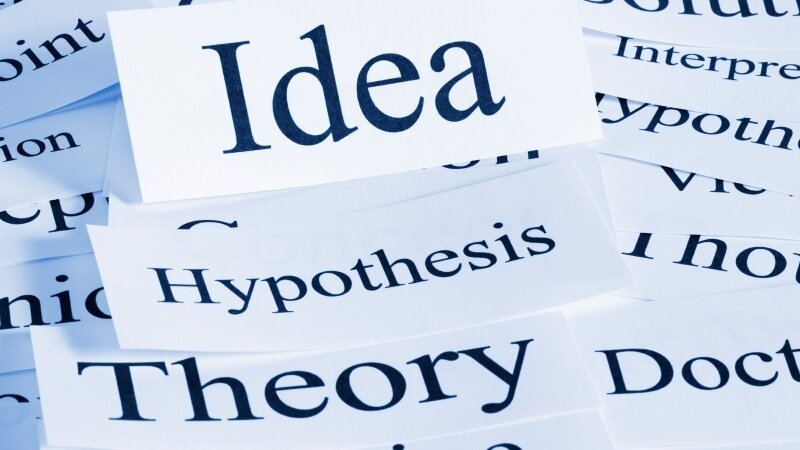
Science Thoughts: theory vs hypothesis #scifi #authorsofscifi

Before I start, have you had a chance to check out our anthology yet? Elements of Untethered Realms is an awesome introduction into all things wondrous and strange! Just sayin' :)


Okay, so to get this going, I am going to give a little caveat: I'm a professor by day and teach a whole lot, coupled with my laboratory research. I find myself in the science realm pretty much constantly. So, when I come across scientific facts that are wrong in novels, I totally know that most people don't have the background I do and can let some things slide.

But there are a few things that bug me a whole lot. They're too basic and actually kind of important distinctions :)

The key there is basic--if you're going to write about science in any way, mostly that means you've at least got the basics down, and I love that! But a few times I stumble across things that leave me going "ummmmm...." One of these was just this past week in a novel by a NYT bestselling author whose work I *adore*! And yet, there on the page, with two characters conversing who she had set up as being very good at science, there was this major issue that made me roll my eyes a little.

Theory was used instead of hypothesis.

See, theory has two meanings. I know it's easy to get confused. But, when it comes to being used in a novel, it's good to get it right because it's something that needs to be well understood by the general public. I'll get into that later. Anyhow, the two definitions of theory are perhaps best understood this way:

"In theory, Mr. Peacock killed the butler." <-- in other words, it is not established or proven. This is the sense that is often used in layman's terms in general conversation.

It is not to be confused with:

"The theory of gravity." <-- This is the scientific meaning. In which case, there is a huge body of evidence that supports gravity (including why you are able to stay pegged to the ground and not lift off into space ;). It is something that is very well established, but because the nature of science IS questioning, we don't say that is is Law. That's how science works.

So, having two characters chatting about how a scientific idea is "just a theory" is ostensibly like saying that they've already proven the idea, had years and years of testing by many individuals, and generally it's considered to be the way the universe works. What should have been used is the word "hypothesis." This is an idea that is yet to be demonstrated through data collection and testing. You hypothesize that something may be correct, but you need to test it first. And even then, it'll be many, many tests and trials before it can even dream of becoming a theory.

Why is this such a soapbox for me? Well, because so many people clamor that something is "just a theory" when referring to a scientific idea. That's like saying that gravity isn't real. That the earth isn't round. That we don't orbit the sun. These are "just" theories. They are points upon which a ton of evidence rests. So the two definitions of "theory"--both for general layman's usage and in science--get confused. But in a novel it's a good idea to get the right. (Unless you're making a point with a character using the wrong one or something--obviously there's creative license here ;). And that's why I sighed and rolled my eyes while reading that (otherwise awesome) novel the other day.

What do you think? Have you seen this be misused? :)

2.13.2018

Untethered Realms Welcomes Alex. J. Cavanaugh


The Realities of Space Travel

Speculative fiction provides us the opportunity to explore beyond our world. Writers get to imagine what’s beyond the edge of our solar system while trying to infuse as much reality as possible. Just what are the realities of space flight though?

Travel time isn’t as fast as portrayed in the movies. We haven’t achieved light speed. Not even close! The space shuttle traveled at a rate of 18,000 mph/29,000 km/h. It can circle the Earth in ninety minutes, but getting all the way to Mars would take over six months. With current technology, it just isn’t going to go much faster.

That leads us to the next reality - ship requirements if we’re to travel farther than the moon. It would take a much larger ship than the space shuttle. It would need to store more supplies, possess a stronger propulsion system, more shielding against radiation, and larger accommodations for the crew. They would also need room to carry equipment for Mars or whatever planet was their destination. They are working on a ship that can travel to Mars, but that’s a lot of things they need to consider when constructing it.

Perhaps the scariest reality is the effect of space travel on the human body. Without gravity, an astronaut’s bones lose minerals at a rate of 1% a month. On earth, the average is a little over 1% per year. Astronauts also experience pressure in their heads and vision problems, along with mental difficulties resulting in depression or sleep disorders. Radiation is a problem–on the space station, humans receive ten times plus the amount of radiation as they would on Earth. This increases the chance of cancer, radiation sickness, and nervous system damage. After six months on the space station, astronaut Scott Kelly’s skin became super-sensitive and he developed a hive-like rash whenever he touched anything. These issues would compound during a long trip, bordering on life-threatening.
 
This is where the freedom of being a speculative fiction writer comes into play. Unless we are writing about current or near-future situations, we can circumvent these issues. We can invent things in our minds that will not only solve these problems but propel us beyond existing projections. Set a story in another solar system or galaxy and we can blow past all imagination. The boundaries of space no longer apply.

We need to be aware of the limitations of today’s space travel, but we don’t have to be confined by them!


About our awesome guest: Alex J. Cavanaugh has a Bachelor of Fine Arts degree and works in web design, graphics, and technical editing. A fan of all things science fiction, his interests range from books and movies to music and games. Online he is the Ninja Captain and founder of the Insecure Writer’s Support Group. He’s the author of Amazon Best-Sellers CassaStar, CassaFire, CassaStorm, and Dragon of the Stars. The author lives in the Carolinas with his wife.


Find Alex on his website, Twitter, and the IWSG.

1.19.2016

An Odd Creature that isn't Fiction to Inspire Aliens and Monsters

The Yeti Crab

It's hairy, it's white. It lives near the thermal vents in the ocean floor where hot water gushes into the sea.

There are three known species. One resides in the Southern Ocean off Antartica and it grows its own food.

What?

Yes, its favorite snack is bacteria which grows in the 'hairs' (setae) on its body. Now that's convenient!

LEARN MORE


Want to be introduced to 5 more bizarre species that share our planet? Visit mpaxauthor.com tomorrow (1/20)


7.22.2014

I Am Made of the Right Stuff #space #marsone


At only 5 ft in height, I'm 5 cm too short to apply for the Mars One mission. Actually, I probably don't meet many of their other astronaut requirements. Sucks, doesn't it? To be told you're not good enough for something because of your physical capabilities. To be told, you're not the right stuff. I'd love to have had the chance to just apply to be on the first manned mission to Mars. I'm honest enough with myself to know I probably wouldn't have made it past the first round, but you never know.

However, that doesn't mean the opportunity to go to space will never happen. It doesn't mean I'll always be too short.Who knows what the future holds? What advances in space flight there will be in my lifetime. I could be the right stuff for the right mission.

Am I crazy for still believing I have a chance? Or is it that belief in our dreams that drives us towards achieving those impossible goals? What do you think? What are your crazy, impossible dreams?